INTELLIGENCE HUB
The Trader's Journal
Market insights and beginner guides for the Nairobi Securities Exchange.

FeaturedJune 2, 2026
Why Do We Accept Losing Our Life Savings As The Normal Cost Of Learning The Nairobi Securities Exchange?
The traditional belief that losing your core savings is an unavoidable rite of passage on the Nairobi Securities Exchange is a profound structural error. While the current ecosystem traps retail traders between the blind panic of hyperactive social media tip groups and clunky unguided brokerage apps, true market longevity demands an education first framework. This article exposes the unwritten tragedy of the modern investing landscape and introduces a risk free sanctuary where independent analytical competence is systematically forged using real time market telemetry before a single real shilling is ever placed on the line.

Pukka Sam
Author

Urim Trader
Who Actually Profits When You Trade On Chatroom Rumours Instead Of Brutal Mathematical Proof?
The transition from a vulnerable beginner to a seasoned market operator on the Nairobi Securities Exchange requires completely destroying the habit of emotional speculation. This analytical breakdown exposes the lethal illusion of standard diversification and introduces the institutional grade mathematics required to survive volatile market shifts. By fusing ten thousand probability paths with three dimensional asset comparisons, resonance risk tracking, and rigorous historical back testing, we reveal exactly how to transform equity trading from a chaotic digital casino into a disciplined, quantifiable science.
Pukka SamAuthor
Jun 3, 2026Journal →
Tax Compliance
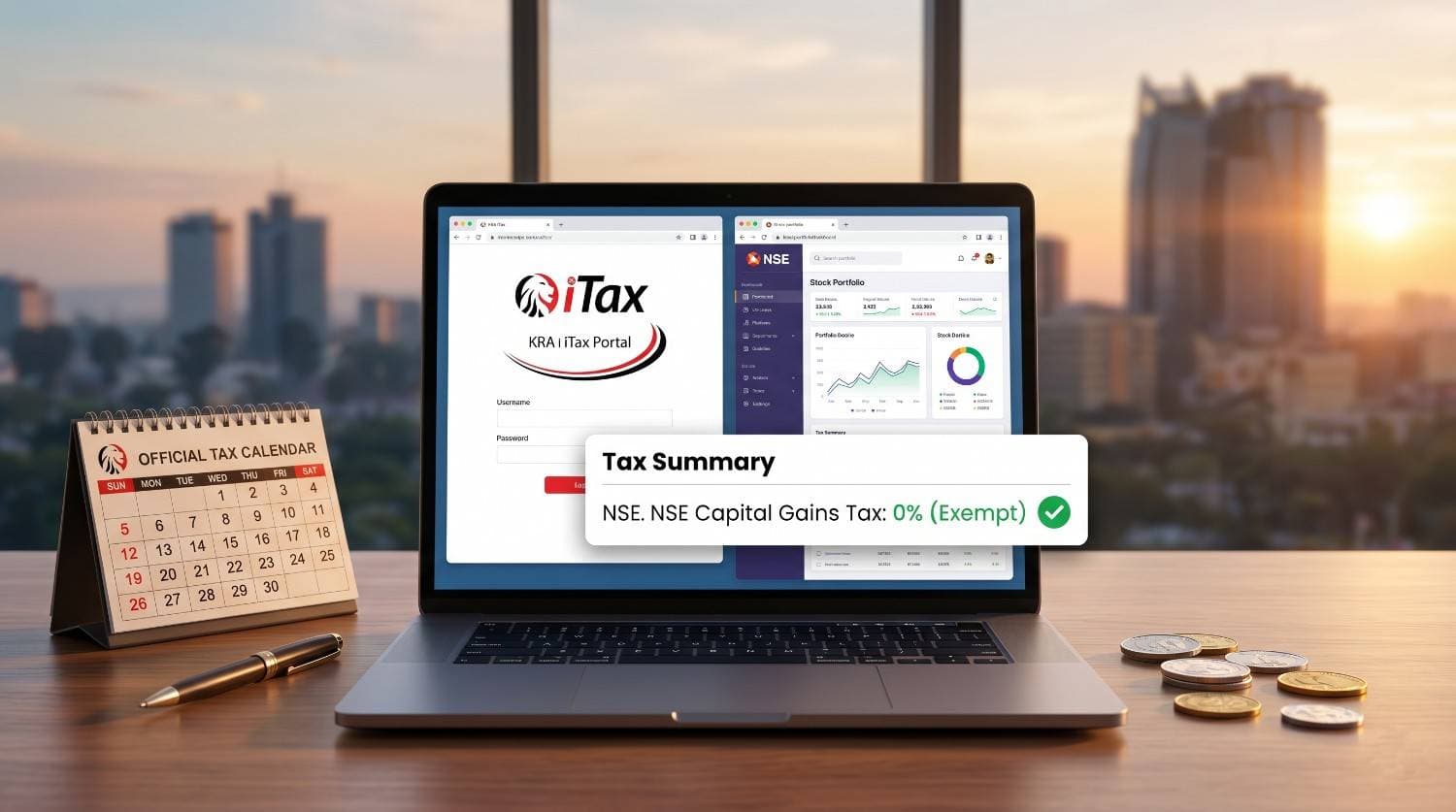
Do You Understand Your True Tax Obligations on the Nairobi Securities Exchange? A Complete Guide to Taxes on NSE Share Investments
The relationship between a retail investor and the Kenya Revenue Authority does not have to be an expensive game of cat and mouse. While the standard narrative around local revenue collection focuses heavily on aggressive tracking and rising penalties, the capital markets hold a collection of deliberate, legal loopholes designed to protect investment gains. This article functions as an operational blueprint to navigating the hidden fiscal advantages of the Nairobi Securities Exchange. We strip away the textbook definitions to mathematically contrast the transactional drag of high frequency trading against patient capital, analyse the regional isolation of the five percent final withholding rate, and outline the exact steps required to complete your June iTax filing without triggering automated compliance fines.

Wanjiku KibiruAuthor
May 29, 2026Journal →

Dividends
Power of Dividends 2: How Can You Strategically Turn Nairobi Securities Exchange Pay-outs Into a Million Shilling Compounding Machine?
Receiving a dividend notification on your phone is exciting but simply collecting a cash payout is not an investment strategy. This fundamental guide breaks down the mathematical reality of execution frameworks like dividend reinvestment programs on the Nairobi Securities Exchange while detailing the specific quantitative checks required to protect your capital from lethal yield traps.
Wanjiku KibiruAuthor
May 27, 2026Journal →
Master the NSE Election Cycle
Live MasterclassOct 31st • Early Bird KSh 1,000 (Reg. KSh 1,200)Live practical strategy session with Dedan Maina (CFA). Separate election market noise from genuine opportunity.

Dividends
The Power of Dividends; How Can You Turn NSE Dividends into a Compounding Wealth Machine This Season?
The 2026 AGM season is showering NSE investors with record breaking payouts. But while millions flow out of Safaricom and Absa Bank most retail investors still fail to grasp the true power of dividends. Discover how to apply the timeless strategies of Warren Buffett and Benjamin Graham to build a resilient passive income portfolio on the Nairobi Securities Exchange.
Wanjiku KibiruAuthor
May 25, 2026Journal →

I and M Group
Is I and M Bank Quietly Becoming The Most Attractive Growth and Dividend Play on the NSE?
I and M Holdings has quietly outperformed the broader market recovery by posting an impressive 17.79 percent gain year to date. Backed by a stellar 22.12 percent jump in net income and a corporate bond offer that cleared a staggering 232.26 percent subscription rate this financial breakdown explores the exact mathematical metrics and dividend yields proving why this banking tier one contender is a rare compounder for investors.
Pukka SamAuthor
May 22, 2026Journal →

Energy Sector
Will the End of Kenya Powers Monopoly Crash or Supercharge the Nairobi Securities Exchange?
For decades Kenya Power held an absolute monopoly over electricity distribution but new EPRA regulations have officially opened the grid to private power producers. This structural shift allows industrial giants to bypass KPLC entirely triggering massive volatility on the NSE. Discover why power generators like KenGen are poised for explosive growth how the manufacturing sector will cut operational costs and the systemic debt risks threatening KPLC and major Kenyan banks.
Pukka SamAuthor
May 20, 2026Journal →

Finance Bill 2026
How Will the Finance Bill 2026 Proposals Impact Your Capital Gains and Crypto Assets in Kenya?
The second part of the Finance Bill 2026 introduces massive shifts for investors in Kenya. From new capital gains taxes on offshore share transfers to the revenue authority tracking your crypto assets and heavy taxes on retained earnings we break down exactly how these proposals will impact your portfolio. Discover the hidden wins for real estate trusts and what you must do to protect your wealth.
Wanjiku KibiruAuthor
May 18, 2026Journal →

Finance Bill 2026
How Will the Finance Bill 2026 Reshape Your Taxes and Investment Strategy?
The Finance Bill 2026 is transforming the Kenyan tax landscape with stricter enforcement earlier deadlines and increased rates for landlords. Discover the hidden wins for salaried employees and the critical changes business owners must prepare for before these proposals become law.
Wanjiku KibiruAuthor
May 15, 2026Journal →

NCBA Group PLC
Nedbank’s Bid For NCBA: With A 105 Shilling Buyout Price Should You Sell Your NCBA Shares to Nedbank or Hold for the Long Haul?
South African financial giant Nedbank has officially launched a 110 billion shilling tender to acquire a controlling 66 percent stake in NCBA Group. Valuing the bank at 105 shillings per share this transformative transaction offers retail investors holding less than 9400 shares a complete cash buyout. We break down the exact terms of the deal the strategic reasons behind the acquisition and what every shareholder needs to do before the tender closes in July.
Wanjiku KibiruAuthor
May 13, 2026Journal →

Volatility
Understanding Volatility: Why Some NSE Stocks Swing Wildly and How to Master the Chaos
If you have ever wondered why some NSE stocks sit frozen for weeks while others swing wildly by the hour, the answer is volatility. Instead of fearing these sudden price jumps, smart investors use a metric called Beta to measure exact market sensitivity. In this breakdown, we reveal what causes these violent swings and how you can use institutional grade tools to turn market chaos into calculated opportunities.
Pukka SamAuthor
May 11, 2026Journal →

Safaricom
With over a 100 billion Shilling Profit and Record Dividends Is Safaricom the Ultimate Buy on the NSE Right Now?
Safaricom just released its strongest financial results in history, hitting a massive 100 billion shilling net income and declaring the largest dividend ever seen on the NSE. We break down the numbers, the narrowing Ethiopia losses, and what this record breaking pay-out means for the future of your portfolio.
Wanjiku KibiruAuthor
May 8, 2026Journal →

Absa Bank Kenya
What is Driving the Massive Investor Rush Toward Absa Bank Shares This Year?
Absa Bank Kenya has dominated investor attention recently, surging 20 percent year to date. But what is truly driving this momentum? We break down the numbers behind the rally, from a 10 percent increase in profits and a reduced non performing loan ratio to a 17 percent dividend hike. More importantly, we analyse the banks aggressive acquisition strategy and its push into the wealth management sector. Discover whether this banking heavyweight is a sustainable long term play or if tightening lending margins present a hidden risk.
Wanjiku KibiruAuthor
May 6, 2026Journal →

Financial Education
What If Everything You Need to Master the Nairobi Securities Exchange Was in One Place?
Since launching the Urim Trader blog, our mission has been singular: to provide every Kenyan investor with institutional grade intelligence presented in plain language. Whether you are a complete beginner trying to understand a CDS account, or a seasoned investor navigating the Central Bank's latest interest rate decisions, we have built a comprehensive roadmap for your journey. From mastering market mechanics and spotting diversification traps, to deep dive analyses on heavyweights like Safaricom and Britam, this index is your complete guide to everything we have published so far. Stop guessing, and start building your financial competence today.
Wanjiku KibiruAuthor
May 4, 2026Journal →

Dividend Yield vs Dividend
The NSE's Most Expensive Dividend Trap: What Do Institutional Investors Know That Retail Buyers Keep Ignoring?
The appeal of waking up to passive income from the Nairobi Securities Exchange is undeniable. But blindly chasing the highest dividend yield is often a dangerous trap that can decimate your capital. If a company pays you Ksh 5 in dividends but its share price collapses by Ksh 15 due to poor management, you haven't made money you've lost it. We break down the critical mathematical difference between absolute dividends and dividend yields, how to spot artificial Value Traps, and the three safety pillars you need to build a bulletproof passive income portfolio.
Pukka SamAuthor
Apr 29, 2026Journal →

Kenya Airways
Is the 92% Surge in Kenya Airways (KQ) a Genuine Turnaround or the Ultimate Speculative Trap?
Kenya Airways (KQ) has suddenly surged by 92% this year following massive share acquisitions by political heavyweights and rumors of a multi-billion shilling foreign buyout. But when you strip away the market noise, the fundamentals tell a different story. With a brutal Ksh 17.2 billion net loss in 2025 and over a decade of nearly uninterrupted negative equity, is this stock a brilliant long-term play or a dangerous, narrative-driven gamble? We break down the hard numbers behind the NSE's most talked-about counter.
Wanjiku KibiruAuthor
Apr 24, 2026Journal →

Sector Resonance
Are You Investing in the NSE or Just Buying a Lottery Ticket?
Many retail investors treat the Nairobi Securities Exchange like a lottery ticket buying shares based on hype and calling it diversification. But buying five different bank stocks does not protect your wealth it creates a dangerous overlap called Resonance Risk. Discover how to stop trading blind and use institutional grade AI intelligence to strip away market noise evaluate macro market rotations and protect your portfolio from sudden collapse.
Pukka SamAuthor
Apr 22, 2026Journal →

Sectors
How Well Do You Actually Know the 12 Sectors of the Nairobi Securities Exchange? Are You Dangerously Concentrated?
The Nairobi Securities Exchange has evolved into a highly sophisticated marketplace of over 63 companies spread across 12 distinct sectors. From the massive index weight of Telecommunications and Banking to the newly expanded Exchange Traded Funds (ETFs) and the historic 2026 Kenya Pipeline Company IPO, understanding these industry categories is the absolute foundation of a sound investment strategy. Here is a complete, deep-dive breakdown of every sector driving Kenya’s capital markets and how they dictate the structural health of your portfolio.
Wanjiku KibiruAuthor
Apr 20, 2026Journal →

Britam Holdings
Britam is Up 37 Percent This Year, but is the Recovery Rally Actually Sustainable?
Britam Holdings has quietly become the most viewed and traded stock on the Urim Trader simulator this week, boasting a massive 37.7 percent year to date gain. With profits hitting KSh 7.9 billion and corporate debt slashed by 90 percent, the financial giant is showing serious fundamental recovery. However, with zero dividends declared for FY2025 and a heavy reliance on investment gains rather than core underwriting, is this a genuine breakout or just a temporary momentum play? We dive into the exact numbers driving the current market hype.
Wanjiku KibiruAuthor
Apr 17, 2026Journal →

Stockbroker
Which Nairobi Securities Exchange (NSE) Stockbroker is Actually the Best for Your Portfolio?
Choosing the wrong stockbroker on the Nairobi Securities Exchange can turn a disciplined investing strategy into an incredibly expensive habit. Two investors can buy the exact same stock and get wildly different returns simply because of brokerage fees, execution speed, and hidden charges. From traditional institutional giants like Dyer & Blair to the new mobile-first Ziidi Trader, we break down the rates, locations, and core strengths of Kenya’s top 16 licensed brokers to help you find the perfect fit for your capital.
Wanjiku KibiruAuthor
Apr 15, 2026Journal →

Macroeconomics
The End of Easy Money: How Will the Latest CBK Decision and the End of Easy Money Impact the Nairobi Securities Exchange?
The Central Bank of Kenya has officially paused its ten-month rate-cutting streak, holding the CBR at 8.75% just as global conflicts threaten fuel prices and the shilling. But what does this macroeconomic pivot actually mean for the Nairobi Securities Exchange? Discover how this shift stabilizes banking margins, squeezes manufacturing, triggers foreign capital flight in telecoms, and why defensive dividend stocks are becoming the ultimate safe haven in 2026.
Pukka SamAuthor
Apr 10, 2026Journal →

Safaricom
Safaricom Shares Analysis 2026: Why Are the NSE Investors Still Watching?
Safaricom (NSE: SCOM) continues to dominate investor attention, accounting for over a third of the NSE's total equity value. But is the telecom giant still a smart buy in 2026? Driven by M-PESA’s massive fintech moat and trading at a 24% discount to its 10-year historical P/E, Safaricom presents a compelling case for value and dividend investors. Dive into our comprehensive 2026 analysis to explore the company's fundamentals, the high-stakes Ethiopia expansion, recent Vodacom ownership changes, and the critical risks every investor must monitor.
Wanjiku KibiruAuthor
Apr 8, 2026Journal →

Stockbroker
What Exactly Does Your NSE Stockbroker Do Behind the Scenes?
A stockbroker is your entry point to the Nairobi Securities Exchange as an investor. Through them, you can get a CDS account, access the NSE live, place buy and sell orders, and follow through with your portfolio valuation. Ultimately, they act as the crucial intermediary in the ecosystem bridging you, the NSE, and the CDSC settlement systems.
Wanjiku KibiruAuthor
Apr 1, 2026Journal →

Regulation
Are Your Shares on the NSE Actually Safe, and Who Exactly is Protecting Them?
Ultimately, when you buy shares on the Nairobi Securities Exchange, you are essentially trusting a complex system. This is a system that carefully regulates the market, closely monitors the stakeholders involved such as your chosen stockbroker, and securely protects your shares and your money. As you navigate this system, you might logically ask exactly who regulates these brokers, who specifically keeps your shares secure, and who ultimately ensures that the entire market remains completely fair.
Wanjiku KibiruAuthor
Mar 30, 2026Journal →

Diversification
Is Your NSE Portfolio Actually Diversified, or Just Highly Vulnerable?
While understanding these individual sectors is undeniably incredibly useful, actually seeing how they interact with each other in real time is where your real advantage as an investor truly begins. For instance, you might honestly think you are perfectly diversified by holding five completely different stocks in your account. However, if those specific stocks happen to be KCB, Equity, Co op Bank, NCBA, and ABSA, your entire portfolio is completely exposed to a single economic shock.
Pukka SamAuthor
Mar 27, 2026Journal →

Performance
Can You Really Outperform the NSE? What the Data Reveals in 2026
It is the ultimate ambition for any investor to select the right stock at the precise moment required to outperform the market average and accumulate wealth faster than the broader index. While many dream of this financial edge, the question remains whether beating the market is a realistic goal for the average person. The short answer is that it is certainly possible, but it remains an exceptionally difficult feat that requires immense discipline and a data driven approach.
Pukka SamAuthor
Mar 25, 2026Journal →

Basics
How the NSE Works: From Buying Your First Share to Getting Dividends
Many people delay investing because they think it is complicated, but in reality, the process is quite simple. It primarily requires intention and a clear sense of order to navigate the Nairobi Securities Exchange successfully. From opening your CDS account to choosing a broker and executing your first trade, the goal is to learn through the process while limiting your risk. Buying your first stock builds a level of confidence and practical understanding that no classroom can ever truly replace.
Wanjiku KibiruAuthor
Mar 23, 2026Journal →

Psychology
NSE History: Understanding Market Memory
The Nairobi Securities Exchange has experienced several significant shocks over the decades, and these moments did not simply disappear once the immediate crisis ended. Instead, they left lasting patterns in how prices move, how investors behave, and how the market reacts under pressure. This phenomenon is what we call Market Memory, which refers to the way the exchange effectively remembers past events through price behavior, volatility patterns, and investor psychology. Even years later, similar economic conditions can trigger echoes of those earlier periods, influencing how current trades unfold.
Pukka SamAuthor
Mar 20, 2026Journal →

History
NSE History: Key Moments and Lessons (1990s to 2026)
Trace the evolution of the Nairobi Securities Exchange from a 1920s gentleman's agreement to the digital powerhouse of 2026. Discover the historical milestones, from the first KCB privatization to the monumental KPC IPO and Zidii Trader launch, that shaped Kenya’s capital market for today's investor.
Wanjiku KibiruAuthor
Mar 18, 2026Journal →

Macroeconomics
Macroeconomic Reality Check: How Tax Shortfalls and Debt are Shaping the NSE in 2026
Kenya’s 2026 fiscal landscape is shifting as tax shortfalls meet record-breaking domestic borrowing. Discover how the Crowding Out effect is starving the stock market of liquidity and what this means for your banking, manufacturing, and telecom holdings. Learn why fixed income is currently outperforming equities and how to adjust your NSE strategy to survive a bearish economic cycle.
Pukka SamAuthor
Mar 16, 2026Journal →
Protocol Page 1Older Journals