The Power of Dividends; How Can You Turn NSE Dividends into a Compounding Wealth Machine This Season?
PUBLISHED PROTOCOL
May 25, 2026
Wanjiku Kibiru
Author

Every April and May, something quietly extraordinary happens on the Nairobi Securities Exchange. The AGM season, the annual convening of boards, shareholders, and auditors, reaches its peak, and with it comes a cascade of dividend announcements. Banks, Telecoms, Consumer-based companies, Insurance groups, one by one open their books and confirm what they will return to shareholders for the year's work. 2026 has been a particularly significant dividend season. Safaricom declared a record Ksh 2.00 per share total dividend, a 66.7% increase, the largest pay-out in its history. Absa Bank Kenya raised its dividend for the fifth consecutive year. BOC Kenya announced Ksh 10.35 per share. Combined, the dividend cash flowing out of NSE-listed companies to their shareholders in 2026 runs into hundreds of billions of shillings. Yet for many retail investors, even those who have been trading in the NSE for years, dividends remain poorly understood. Some investors buy stocks for all the wrong reasons at all the wrong times. Others ignore dividends entirely, leaving significant wealth on the table. And very few have a deliberate, structured strategy for turning dividend income into compounding returns over time. This article is your complete guide.
What Is a Dividend and Why Should You Care?
A dividend is a portion of a company's profits that the board of directors votes to distribute to its shareholders. It is, in the simplest sense, your share of the business's earnings, a tangible cash reward for trusting a company with your capital. On the NSE, dividends typically come in two forms. The interim dividend, which is declared mid-year, is often declared after the company releases its half-year results. The final dividend is declared after the full-year audited results are approved at the Annual General Meeting. Together, they constitute the total annual dividend.
When a company declares Ksh 2.00 per share as the final dividend, it means that for every share you hold on to the record date, you will receive Ksh 2.00 in cash deposited into your nominated bank account. If you hold 10,000 Safaricom shares, you receive Ksh 20,000. Hold 100,000 shares, and that becomes Ksh 200,000 in cash, without selling a single share. This is the fundamental power of dividend investing: your investment generates income independently of what the share price is doing on any given day. You do not need to time the market. You do not need to find a buyer for your shares. The company's success flows directly into your pocket.
Why Dividends Matter More Than Most Investors Realize
a. Dividends Are Proof of Real Profit
Dividends are one of the most reliable signals that a company's profitability is genuine, not engineered. A company can manipulate its earnings per share through accounting adjustments, changes in depreciation policy, asset revaluations, and deferred revenue recognition. But it cannot fake cash. When a board declares a dividend of Ksh 2.00 per share and pays it to millions of shareholders, that cash is real, and it is gone. Benjamin Graham, the father of value investing and Warren Buffett's mentor, built his entire investment framework around this principle. He argued that the true test of a corporation's financial strength was its demonstrated ability to pay dividends consistently over many years, across different economic conditions.
b. Dividends Provide a Margin of Safety
Consider two investments: Company A pays no dividend but promises 15% annual growth. Company B grows at 8% annually and pays 7% dividend. On paper, Company A looks better. But Company A's growth story depends entirely on the market continuing to value its growth narrative. If sentiment shifts as it did with growth stocks globally in 2022 and 2023, the share price can collapse 50% or more with no cash income to cushion the blow. Company B's investor, meanwhile, has been receiving 7% in cash every year. Even if the share price falls 20%, they have already received enough in dividend income to offset a significant portion of that loss. The dividend creates a margin of safety that growth-only investing lacks.
c. Dividend Reinvestment: The Compounding Machine
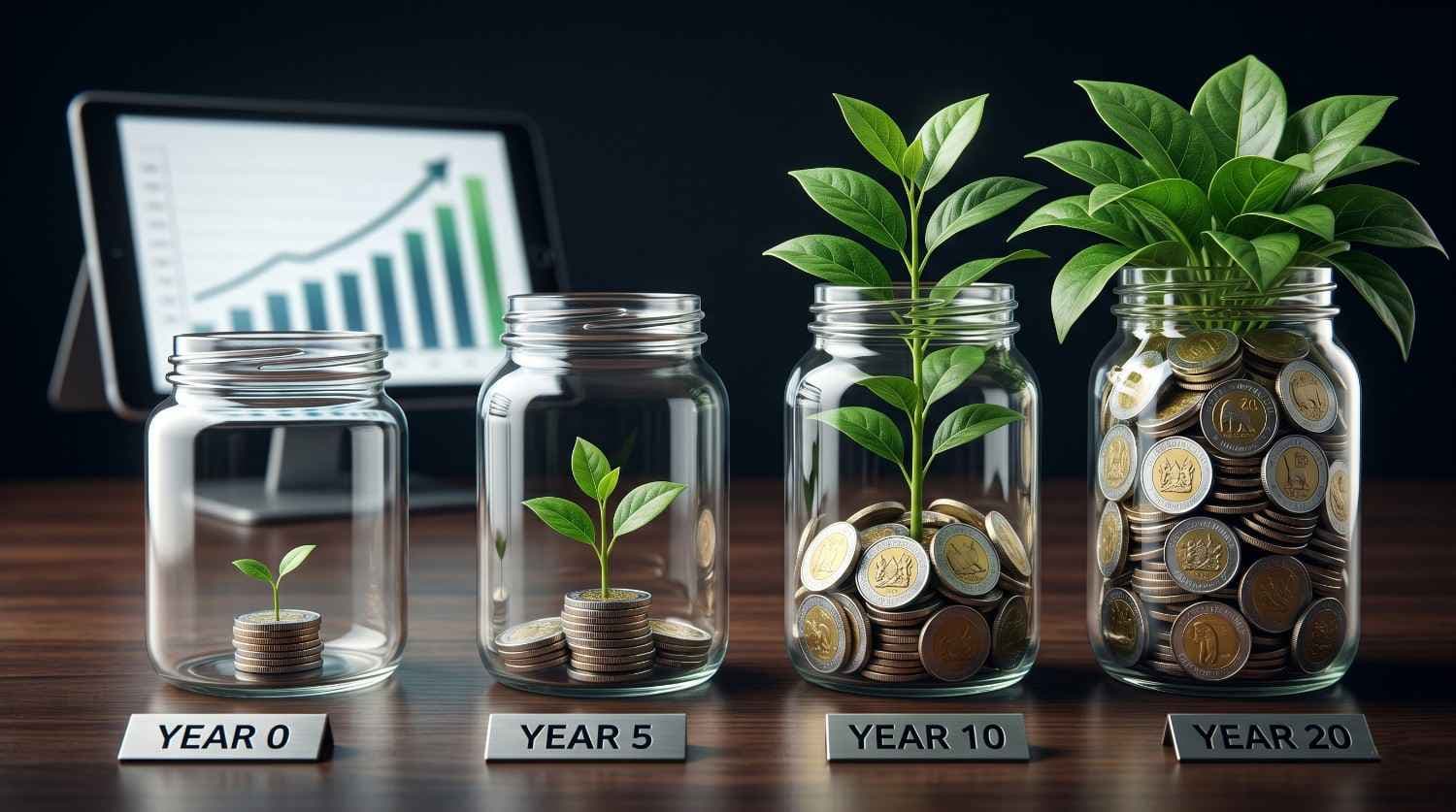
Albert Einstein referred to compound interest as the eighth wonder of the world. Dividend reinvestment is compound interest applied to equity investing. When you take your dividend income and use it to purchase additional shares, those additional shares generate their own future dividends. The mathematics is striking. An investor who holds 10,000 Safaricom shares at Ksh 31, receives Kesh 20,000 in dividends, and reinvests that amount into approximately 645 additional shares will, in the following year, receive dividends not just on 10,000 shares but on 10,645 shares. Over 20 years, this compounding without selling a single share can double or triple the effective income generated by the original investment.
d. Dividends as a Signal of Management Discipline
Companies that pay consistent and growing dividends are making an implicit promise to shareholders: we generate enough cash to fund our operations, reinvest in growth, and still have surplus to return to you. That promise requires discipline, rigorous capital allocation, and confidence in future earnings. This is why Warren Buffett's favourite holding period is forever. He prefers businesses whose dividend-paying capacity confirms the durability of their competitive moat.
"Our favourite holding period is forever. We are just the opposite of those who hurry to sell and book profits when companies perform well, but who tenaciously hold onto businesses that disappoint." — Warren Buffett — Berkshire Hathaway Letter to Shareholders.
A Few Lessons from Warren Buffett and Benjamin Graham on Dividends
No investor education on dividends is complete without grounding it in the wisdom of the two men who have done more to define intelligent investing than anyone else in history. Their lessons, though born in American markets, apply with equal force to the NSE.
Benjamin Graham: The Architect of Dividend Discipline
- Graham's foundational insight was that dividends are not a bonus; they are a right. In his view, a company that retained earnings without paying dividends owed shareholders a rigorous justification for doing so. He established several key principles that remain as relevant to NSE investors in 2026 as they were to Wall Street investors in 1934:
- A company should have an uninterrupted record of dividends for at least 20 years this was its most conservative standard for defensive investors. For Kenyan investors, 5 to 10 years of consistent dividends is a meaningful starting benchmark.
- The pay-out ratio should be sustainable; Graham was deeply suspicious of companies paying out more than 75% of earnings in dividends. Such a ratio leaves no buffer for bad years and may signal that the dividend is being maintained at the expense of the business's health.
- Earnings should cover the dividend by a comfortable margin. The concept of dividend cover (earnings per share divided by dividend per share) should be at least 1.5x, ideally 2x or more, to provide safety during economic downturns.
- The margin of safety principle applies to dividend stocks, too. Even the most generous dividend is worthless if you overpay for the shares that generate it. Buy dividend stocks at a discount to intrinsic value, not at a premium driven by recent hype.
- "An investment operation is one which, upon thorough analysis, promises safety of principal and an adequate return. Operations not meeting these requirements are speculative. “Benjamin Graham, The Intelligent Investor
Warren Buffett: The Master of Dividend-Generating Businesses
Buffett's relationship with dividends is more nuanced than commonly understood. He is, famously, a massive recipient of dividends. Berkshire Hathaway collected over $6 billion in dividend income from its equity portfolio in 2023 alone. Yet Berkshire itself does not pay dividends, preferring to reinvest all earnings at superior rates of return. This apparent contradiction reveals the sophistication of his thinking:
- Receive dividends from great businesses: Buffett's equity portfolio is dominated by businesses like Coca-Cola, American Express, and Apple that generate reliable, growing dividend streams. These dividends provide Berkshire with a growing, capital-free income base.
- Only pay dividends when you cannot reinvest at superior rates: Buffett argues that a dollar retained by a company that can reinvest it at 15% annually is worth more than a dollar returned to a shareholder who can only reinvest it at 8%. A company that retains earnings at high rates of return creates more wealth than one that distributes them.
- Consistency and growth matter more than starting yield: Buffett's Coca-Cola position, purchased in 1988, had a modest starting yield. By 2023, the dividends Berkshire received on its original cost were yielding over 50% annually. Patience and growth compounded into extraordinary income.
- Never overpay for dividend stocks: The fact that a company pays a high dividend does not make it a good investment if the share is overpriced. Buffett's Rule No. 1 never lose money applies as much to dividend investing as to growth investing.
- Understand the business before you invest: Buffett's circle of competence principle means he only invests in businesses he thoroughly understands. An NSE investor buying EABL for its dividend should understand the consumer staples industry, not just the yield percentage.
- "Rule No. 1: Never lose money. Rule No. 2: Never forget Rule No. 1." -Warren Buffett
The Urim Trader Perspective
Dividends are not a passive feature of stock ownership. They are an active tool for wealth building, income generation, and portfolio resilience if you know how to use them intelligently. The NSE in 2026 offers a genuinely compelling dividend landscape. The infrastructure for receiving, tracking, and reinvesting those dividends through your CDS account and your broker's platform has never been easier to access. But the wisdom of Graham and Buffett is indispensable, yielding without understanding is not income; it is risk. The discipline to analyse pay-out ratios, dividend cover, free cash flow, and the sustainability of the underlying business is what converts dividend investing from a passive activity into a compounding wealth machine.
Invest in what you understand. Reinvest what you receive. Ignore what you cannot explain. And never mistake a high number for a safe one.
Related Journals
What are your thoughts?
Enjoyed this analysis?
Join other traders mastering the NSE with Urim.