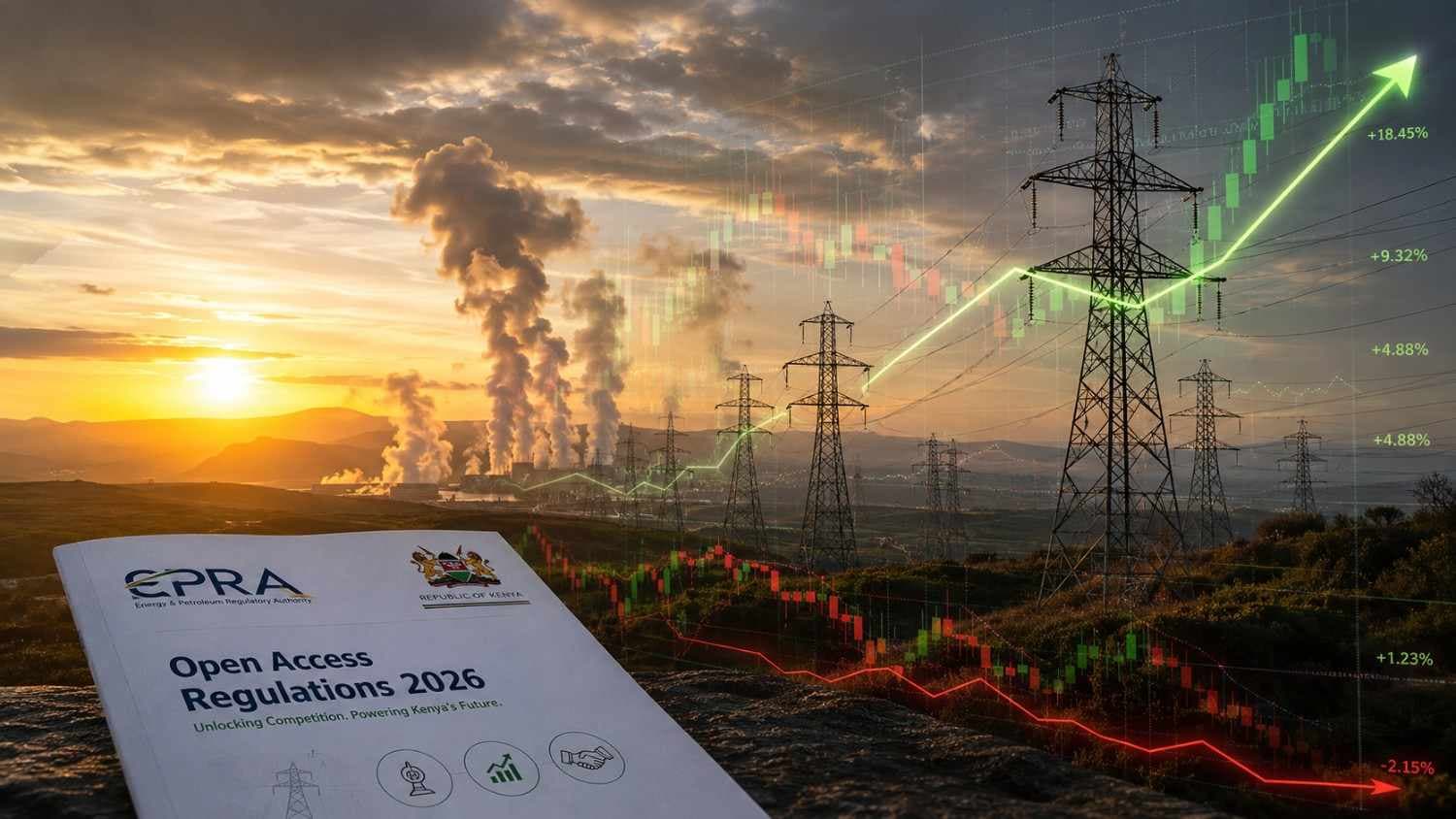
Will the End of Kenya Powers Monopoly Crash or Supercharge the Nairobi Securities Exchange?
PUBLISHED PROTOCOL
May 20, 2026
Pukka Sam
Author

For decades, Kenya Power and Lighting Company (KPLC) has held an absolute monopoly over electricity distribution in Kenya. If you needed power, you bought it from KPLC. That era has officially ended.
On May 8, 2026, the Energy and Petroleum Regulatory Authority (EPRA) gazetted the Energy (Electricity Market, Bulk Supply and Open Access) Regulations. These new rules grant independent power producers the legal right to sell electricity directly to large consumers factories, industries, and major commercial enterprises bypassing Kenya Power entirely.
This is arguably the most significant structural shift in Kenya’s energy sector in history. While the policy debate focuses on consumer tariffs and grid stability, the implications for the Nairobi Securities Exchange (NSE) are massive. This article provides a detailed analysis of how this deregulation will impact specific sectors and stocks on the NSE.
The Wheeling System
It is crucial to understand how this will work in practice. The regulations do not require power producers to build their own parallel power lines. Instead, they introduce a system called wheeling. Private power producers will be granted open access to use the existing national transmission and distribution networks owned by KETRACO and KPLC. In exchange for using these lines, the producers (or the consumers) will pay a regulated wheeling fee to KPLC and KETRACO.
| Feature | The Old Framework | The 2026 Open Access Framework |
| Market Structure | Single-buyer model (Kenya Power). | Multi-buyer, multi-seller market. |
| Target Consumers | Universal (All households and industries). | Large consumers: >1 MVA (distribution) or >10 MVA (transmission). |
| Infrastructure | Owned and exclusively used by KPLC/KETRACO. | Shared infrastructure; IPPs pay a regulated wheeling fee for access. |
| Pricing | Fixed, cross-subsidized tariffs set by EPRA. | Bilateral contracts (1 to 10 years) negotiated directly, subject to EPRA approval. |
The Macro Impact: Winners and Losers on the Nairobi Securities Exchange (NSE)
This regulatory shift creates a clear divide on the NSE. It introduces severe structural risks for KPLC while unlocking unprecedented growth potential for power generators and significantly reducing operational costs for the manufacturing sector.
1. The Power Generators (The Clear Winners)
The most immediate beneficiaries of this regulation are the power generating companies listed on the NSE, specifically KenGen (KEGN).
- The Perks: For years, KenGen has suffered from a single-buyer risk. KPLC was its only customer. If KPLC faced liquidity issues or delayed payments, KenGen’ s cash flow was immediately choked. This regulation allows KenGen to diversify its revenue streams by signing direct, long-term contracts (1 to 10 years) with creditworthy industrial giants. In February, KenGen explicitly stated to investors that direct sales were a core strategy to mitigate KPLC dependency. The regulatory barrier is now gone. This provides KenGen with predictable, high-margin cash flows and reduces its accounts receivable risks.
- The Limitations: KenGen and other Independent Power Producers (IPPs) will still rely on KPLC/KETRACO infrastructure. Any grid failures or maintenance issues on the national lines will still disrupt their ability to deliver power, even if the contract is direct. Furthermore, they will now have to manage customer acquisition, billing, and localized customer service operational complexities they previously outsourced entirely to KPLC.
Stocks to Watch: KenGen (KEGN) is uniquely positioned to capitalize on this. Investors should expect a positive re-rating of the stock as it secures direct industrial contracts.
2. Kenya Power
For Kenya Power (KPLC), the situation is uncertain. This regulation directly attacks its most profitable revenue stream.
- The Threat: Large commercial and industrial consumers are KPLC’ s financial backbone. In the year ending June 2025, these heavy users accounted for a massive 70% of KPLC’ s total electricity sales (7,313 GWh out of 10,570 GWh). These industries pay a premium for high-capacity infrastructure. KPLC uses this premium to cross-subsidize cheaper rates for ordinary households. If major factories migrate to direct contracts with KenGen or other IPPs, KPLC loses its highest-margin customers.
- The Systemic Risk: KPLC is locked into long-term Power Purchase Agreements (PPAs) with generators (including KenGen, Lake Turkana Wind, and OrPower4). KPLC must pay for this power regardless of whether it sells it. If its biggest customers leave, KPLC will be stuck with massive capacity charges and declining revenues. This is the exact financial risk the World Bank warned the government about.
- The Silver Lining: KPLC is not entirely cut out of the equation. It will earn wheeling fees from the IPPs using its distribution network. While this revenue will be significantly lower than selling the power directly, it provides a low-risk, steady stream of toll-like income. Furthermore, this shock may finally force KPLC into aggressive operational efficiency and debt restructuring.
Stocks to Watch: KPLC. Expect heightened volatility. The stock is likely to face downward pressure as the market prices in the potential loss of premium industrial clients.
3. The Manufacturing and Industrial Sector
The companies that actually consume this power, the large manufacturers listed on the NSE, are the secondary winners. Energy costs are often the highest operational expense for these firms.
- The Perks: For years, manufacturers have battled high tariffs, unstable supply, and frequent blackouts, forcing them to invest heavily in expensive backup diesel generators or biomass systems. Direct access allows these companies to negotiate competitive, fixed-rate, long-term power contracts directly with producers. This guarantees price stability and potentially lower overall energy costs, directly improving their EBITDA margins and net profitability.
- The Limitations: The migration process might be slow. EPRA still has to approve the pricing for these direct sales, meaning the immediate cost savings might not be as dramatic as some manufacturers hope. Additionally, if KPLC’ s financial health deteriorates, grid maintenance could suffer, leading to more frequent infrastructure failures that still affect the wheeling process.
Stocks to Watch: Heavy power consumers will see the most benefit. Companies like East African Portland Cement (PORT), Carbacid Investments (CARB), and BOC Kenya (BOC) stand to significantly reduce their operational expenditures, making them more attractive fundamental plays.
4. The Banking Sector - The Indirect Exposure
The banking sector will feel the ripple effects of this transition.
- The Limitations: Kenyan banks have significant exposure to KPLC through syndicated loans and overdraft facilities. If KPLC’ s revenue drops sharply due to the loss of industrial clients, its ability to service this debt could be compromised, potentially forcing banks to increase their non-performing loan (NPL) provisions.
- The Perks: Conversely, the banks that finance the manufacturing sector may see improved credit profiles from those clients as their operational costs decrease and profitability improves.
Stocks to Watch: Major lenders to state parastatals, such as KCB Group (KCB) and Equity Group (EQTY), should be monitored for any statements regarding their exposure to Kenya Power’s debt restructuring.
The end of Kenya Power’s monopoly is not just a headline; it is a fundamental rewiring of the Kenyan economy. For NSE investors, the strategy must shift from treating the energy sector as a monolithic entity to analysing the individual players.
Generators like KenGen are moving from captive suppliers to competitive energy merchants, unlocking massive growth potential. Heavy manufacturers finally have a pathway to lower and stabilize their most crippling operational cost. However, KPLC faces an existential threat to its traditional business model, and its success will depend entirely on how effectively it can pivot to becoming a profitable grid-management and wheeling entity.
As the first direct contracts are signed and EPRA finalizes the wheeling tariffs, the market will rapidly re-price these realities. Investors who understand the mechanics of this deregulation will be best positioned to capitalize on the ensuing volatility.
Related Journals

What are your thoughts?
Enjoyed this analysis?
Join other traders mastering the NSE with Urim.