Do You Understand Your True Tax Obligations on the Nairobi Securities Exchange? A Complete Guide to Taxes on NSE Share Investments
PUBLISHED PROTOCOL
May 29, 2026
Wanjiku Kibiru
Author

Taxes are among the most discussed yet least understood aspects of investing in Kenya. Ask ten NSE investors what taxes apply to their share portfolio, and you will get ten different answers, most of them wrong. Some believe they must pay Capital Gains Tax every time they sell a share. Others are unaware that their dividends are already taxed before they arrive in their bank account. Many have never thought about the cumulative cost of transaction levies on their trading activity. The reality is both simpler and more advantageous than most investors realize. The Kenyan tax framework is, in several important respects, deliberately designed to encourage participation in the capital markets. The NSE exemption from Capital Gains Tax is one of the most generous investor protections in East Africa. The 5% dividend withholding rate is among the lowest in the region. Understanding these facts is not just academic; it changes how you structure your investments, how you think about holding periods, and how you compare the NSE against other asset classes.
This article is the definitive guide. Being in the tax season, whereas Kenyans are required to file the annual tax returns, we cover every tax that affects NSE share investors, dividend withholding tax, capital gains tax, transaction levies, stamp duty, and the changes proposed under the Finance Bill 2026. We explain the rates, the exemptions, the exceptions, the compliance obligations, and the strategic implications for every type of investor on the exchange.
Dividend Withholding Tax
The dividend withholding tax is the most direct tax for the NSE share investments. Every time any of the listed companies pays dividends to its shareholders, it deducts the withholding tax at source before depositing the dividends. In this case, the withholding tax is a final tax, and there is no additional income tax to pay. Kenyan resident investors, EA citizens, and resident company holding companies are charged 5%withholding tax for the dividends received. This applies as the final tax on their NSE investments, and no further corporate and income tax is required. For non-resident investors, a 10% withholding tax is charged.
The final tax on dividend withholding has important implications. It means:
•The 5% deducted is your total and complete tax obligation on that dividend income. KRA cannot assess you for additional income tax on the same dividend.
•You do not need to include dividend income in your taxable income when calculating your PAYE or annual income tax liability. It is a separate, already-settled obligation.
•When filing your annual iTax return, you should disclose dividend income received, but it will not increase your tax payable. The WHT credit already fully covers the liability.
•If you are a company holding shares, and you receive dividends from a company in which you own more than 12.5% of the voting capital, those dividends are fully exempt zero withholding tax applies.
Capital Gains Tax
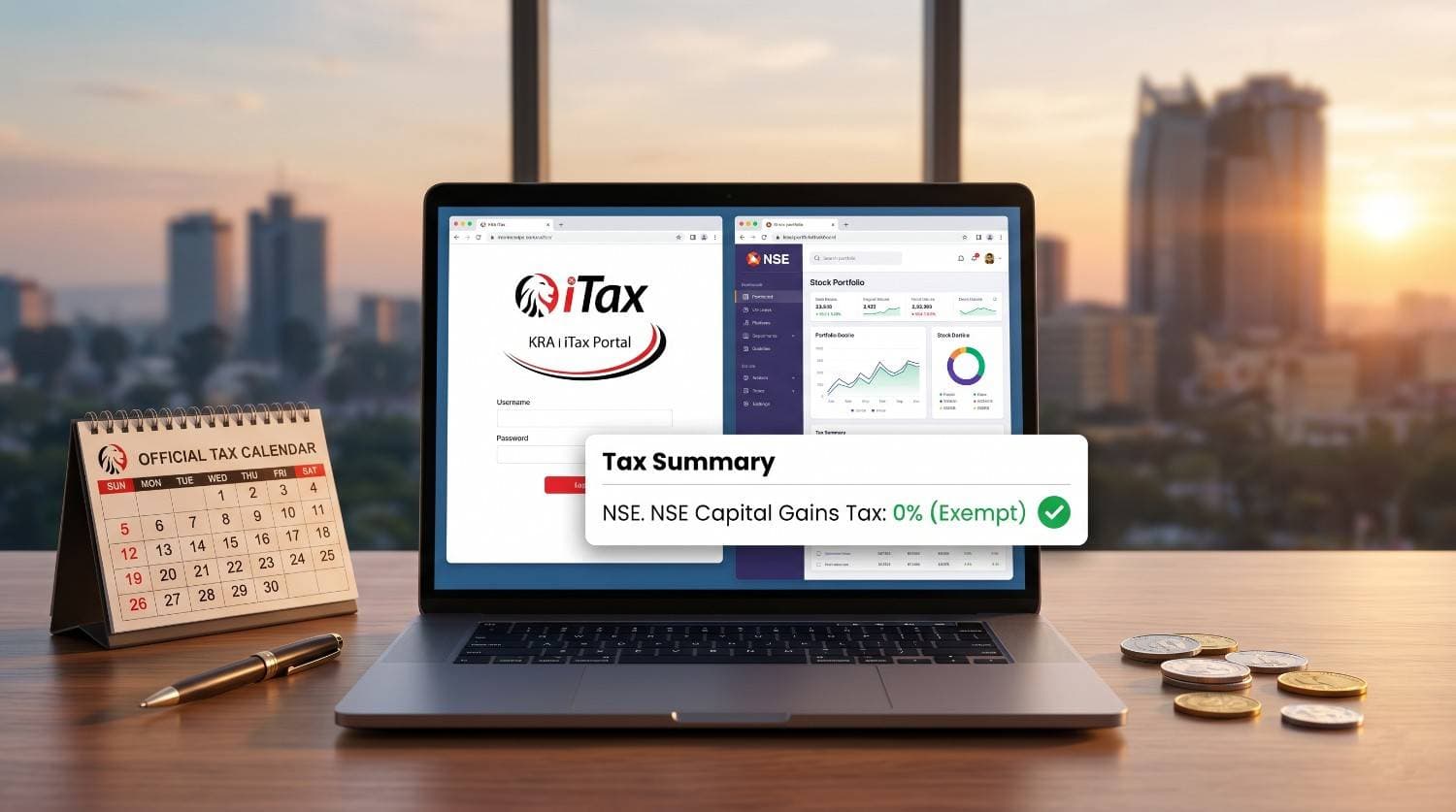
Capital Gains Tax (CGT) is the tax charged on the profit one makes after selling an asset for a higher value than you paid for it. It is one of the most significant taxes for investments, not only in Kenya but globally. However, for the NSE-listed shares, the capital gain tax does not apply. Here is why? In 2015, the law reintroduced a 5% capital gains tax on property and other investment instruments in Kenya. Due to the concerns that the capital gains tax will suppress investment activities and discourage capital market participation, the law was suspended for the securities listed on the NSE. The NSE exemption is retained to this day.
For the transactions where CGT does apply to private company shares, foreign shares with Kenyan property exposure, and certain non-resident disposals, the calculation is straightforward:
Net Gain = Sale Proceeds minus (Acquisition Cost + Incidental Costs)
CGT Payable = Net Gain × 15%
Incidental costs that can be deducted include professional fees, legal costs, and any improvement costs directly related to the property. CGT is a final tax once paid at 15% of the net gain; no additional income tax is assessed on the same gain.
Transaction Costs
Beyond formal taxes, every NSE transaction incurs a set of charges that, while not technically taxes. However, they have the same effect of reducing your net investment returns. Understanding and minimizing these charges, particularly for active traders, is an important component of investment performance management.
Consider an investor who buys Ksh 100,000 of Equity Group shares and sells them six months later for Ksh 115,000, a gross profit of Ksh 15,000 (15% return).
Here is what the transaction costs look like at a brokerage rate of 1.5%:
•Buy transaction costs: Ksh 100,000 × 1.69% (broker + CMA + NSE + CDSC) = approximately Ksh 1,694
•Sell transaction costs: Ksh 115,000 × 1.69% = approximately Ksh 1,944
•Total transaction costs: approximately Ksh 3,638
•Capital Gains Tax: Ksh 0 (NSE listed — exempt)
•Net profit after costs: Ksh 15,000 minus Ksh 3,638 = Ksh 11,362
•Net return: 11.36% on original investment
For a long-term investor who holds for 5 to 10 years, these transaction costs are incurred once on the way in and once on the way out, spread over a long period, and they become negligible. For a short-term trader executing multiple transactions per month, they compound a significant drag on performance. This is one of the mathematical reasons why frequent trading on the NSE is structurally disadvantaged relative to patient, long-term investing.
The Annual Filing Requirement
All Kenyan residents are required to file an annual income tax return with KRA by 30 June each year covering the prior year of income (January to December). This obligation applies regardless of whether your only income is from NSE investments. A return must be filed even if no additional tax is due; failure to file attracts the Ksh 2,000 minimum penalty, regardless of whether you owe anything. For most salaried NSE investors, the Simplified Return on iTax pre-fills your PAYE income from your employer's submissions. You then add dividend income in the appropriate section and confirm the WHT credit. The system will confirm that no additional tax is payable on the dividend income because the WHT is a final tax.
After mastering the tax framework, apply these principles strategically:
- Prioritize dividend income over fixed deposit interest wherever risk is acceptable. Dividend income is taxed at 5% finally. Interest income is taxed at 15%. On an identical pre-tax income of Ksh 100,000, you keep Ksh 10,000 more per year from dividends. Over 20 years, reinvested, that difference compounds dramatically.
- Use the CGT exemption on NSE shares for estate planning. Shares transferred as part of administering a deceased person's estate within two years of death are exempt from CGT. Building a portfolio of NSE shares can be a tax-efficient component of a family wealth transfer strategy.
- For corporate investors, build your NSE holding to above 12.5% of a listed company to receive tax-free dividends. This is clearly only achievable for very large companies or investment vehicles. But for institutional investors and family offices, building to the 12.5% threshold eliminates dividend withholding tax entirely.
- Minimize transaction frequency to reduce the drag of transaction levies. Every unnecessary transaction costs you approximately 1.69% to 2.29% per side. A buy-and-hold strategy that executes ten transactions over 20 years incurs far lower cumulative transaction costs than an active trading strategy executing ten transactions per month.
- File your annual iTax return on time even if no additional tax is due. The Ksh 2,000 late filing penalty applies regardless of your tax position. An investor who receives Ksh 50,000 in dividends annually, with all WHT already settled, still risks a Ksh 2,000 penalty for failure to file by 30 June.
Taxes are not an obstacle to investing in the NSE. In most respects, they are an argument for it. The combination of zero Capital Gains Tax on listed equities, a 5% final withholding rate on dividends, and no further income tax obligation on investment returns makes the NSE one of the most tax-efficient investment platforms available to any Kenyan investor, retail or institutional. The investors who understand this structure do not merely tolerate the tax framework. They use it deliberately. They hold quality stocks for years rather than trading frequently. They prefer dividend income over interest income wherever the risk-adjusted returns are comparable. They time their share disposals to maximize the benefit of the CGT exemption. And they file their returns on time, every year, without exception.
Know your taxes. Use them strategically. And never pay a penalty that could have been avoided with five minutes on iTax.
Related Journals


What are your thoughts?
Enjoyed this analysis?
Join other traders mastering the NSE with Urim.